
Server Management Cost: What You’ll Actually Pay in 2025
Server management cost runs from $50 to several thousand dollars monthly. I’ve watched companies pay $50 and get solid value. I’ve seen others pay $400 and get nothing that mattered.
The range makes sense once you realize server management pricing isn’t about features. It’s about who makes the decisions.
A $50/month provider and a $500/month provider aren’t offering the same service — even when their feature lists look identical. And those lists? They’re mostly noise designed to look impressive without telling you what actually happens when something breaks.
Pick any provider’s website. You’ll see lists like this:
- Nsswitch hardening
- host.conf hardening
- chkrootkit
- rkhunter
- firewall tuning
Unless you’re a system administrator, that means nothing. Which is the problem.
When you can’t evaluate what’s being offered, you default to picking the longest list. I’ve watched this happen for years. Someone sends a request: “Need price for all these services” — and it’s a 50-item list copied from the most impressive-looking website they found.
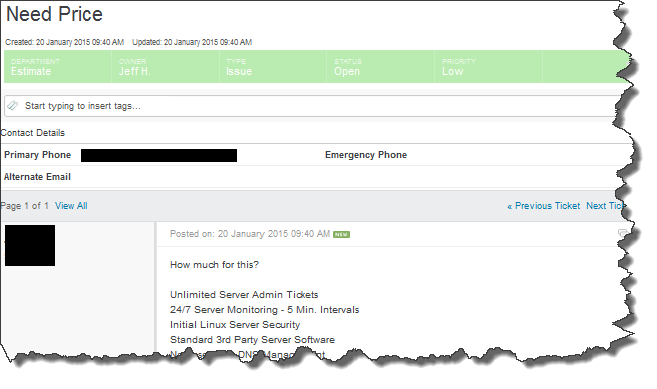
The length of a feature list tells you nothing about whether the service will reduce your operational burden or just create a new coordination problem.
What drives server management pricing
I looked at 50 different server management companies. The pricing spread wasn’t random. Three clear patterns emerged — not based on features, but on who makes the decisions.
That’s the real variable in managed server costs: decision-making responsibility.
Some providers expect you to tell them what to do and when. Others evaluate your environment and handle everything. The difference shows up in the price, but more importantly, it shows up in whether the service actually reduces your workload.
Budget tier: $50-150 per month
Budget providers are execution services. You decide what needs to happen. They do it.
Need a security patch applied? You identify it, you approve it, you schedule it. They log in and run the commands. Response times run in hours, even for urgent issues. Support is ticket-based. You’re managing the service as much as they’re managing the server.
This works if you have someone internal who knows what good server management looks like but doesn’t have time to SSH into boxes all day. It doesn’t work if you’re hoping the provider will tell you what needs attention.
The low server management cost reflects what you’re buying: labor, not judgment.
Managed service tier: $200-500 per month
Managed service providers make the operational decisions. They monitor your environment, identify what needs to happen, and do it. You get notified, but you’re not directing every action.
Security updates? They evaluate, test, and deploy on a schedule. Backups? They configure, monitor, and verify. Performance issues? They investigate and resolve before you notice.
The scope varies widely between providers. Some focus narrowly on server infrastructure. Others include application-layer monitoring, database optimization, or disaster recovery planning. That’s why managed server costs have such a wide range — you’re paying for different levels of coverage and response capability.
This model works when you lack internal expertise or when the time cost of supervising a budget provider exceeds the price difference. You’re buying operational continuity, not just technical execution.
Enterprise tier: $1000+ per month
Enterprise providers handle full lifecycle management. They assess your needs, design the infrastructure, deploy it, maintain it, and eventually help you migrate off it when requirements change.
You’re not buying server management. You’re buying IT strategy that happens to include servers. These providers integrate with your broader technology planning — procurement, compliance, vendor management, capacity forecasting.
The economics only work at scale. If you’re running a handful of servers, the overhead doesn’t justify itself. If you’re managing infrastructure across multiple locations with compliance requirements and uptime SLAs, the cost makes sense.
How much does server management cost for your situation?
The question isn’t “what’s the right price?” It’s “what’s the right fit?”
Three questions cut through the noise:
Do you have the time to direct server management activities? If you’re evaluating security bulletins, prioritizing patches, and scheduling maintenance windows, a budget provider can execute what you decide. If that sounds exhausting, you need someone making those calls.
Do you have the expertise to make good decisions? Knowing that a kernel update is available is different from knowing whether applying it will break your application stack. If you’re uncertain, you need a provider with operational judgment, not just technical skills.
Does the provider help you keep promises to your users? Your customers don’t care about your server management pricing. They care whether your site loads, whether their data is safe, whether you’re available when they need you. The right provider reduces the risk that you’ll break those promises.
What pricing doesn’t tell you
The monthly fee is one data point. It doesn’t tell you:
- How fast they respond when something breaks at 2am
- Whether they’ll proactively identify issues before they cause downtime
- If they understand your application well enough to make safe changes
- Whether their monitoring actually catches problems or just generates noise
- How they handle security patches and system updates
- What happens when you need changes outside their standard scope
I’ve seen companies pay $50/month and get excellent value because their internal team knew exactly what they needed. I’ve seen companies pay $400/month and get nothing because the provider’s “comprehensive management” didn’t include the three things that actually mattered for their application.

Questions to ask before comparing costs
Before you compare managed server costs, get clarity on what you’re actually buying:
Who decides what gets done? When a security update is released, does the provider evaluate and apply it, or do they wait for you to approve it? When performance degrades, do they investigate and fix it, or do they alert you and wait for direction?
What’s included in monitoring? Are they checking that the server responds, or are they monitoring application health, database performance, and user experience? There’s a difference between knowing a server is up and knowing your business is functioning.
How do they handle after-hours issues? A 2am database crash doesn’t care about business hours. Does their pricing include 24/7 response, or is that an add-on? What’s the actual response time — acknowledgment or resolution?
What happens when you need something outside the standard scope? Application deployment, database migration, architecture changes — are these included, billed separately, or not offered? Knowing the boundaries prevents surprise bills.
How do they approach security and compliance? Do they follow industry best practices? Can they document their processes for audit purposes? Do they understand your specific compliance requirements?
The real cost of cheap server management
The lowest server management cost often creates the highest operational cost.
If you’re spending hours each week coordinating with your provider — prioritizing their ticket queue, explaining context they should already have, following up on incomplete work — that’s not savings. That’s overhead with a small monthly fee attached.
If they’re not catching issues until customers report them, you’re paying twice: once for management that isn’t managing, and again in lost revenue and reputation.
[EXAMPLE: Small e-commerce company] I watched a company lose three days of sales because their budget provider waited for approval before addressing a database performance issue. The $100/month they saved on server management cost them $15,000 in revenue. The provider did exactly what they were paid to do — wait for instructions. The company expected them to act.
The goal isn’t to minimize the monthly invoice. It’s to pay for something that actually reduces your operational burden and risk.
When server management doesn’t make sense
Sometimes the right answer is spending nothing on server management.
If your infrastructure is simple and stable, if you have capable people internally, if the time cost of coordination exceeds the value of outsourcing — keep it in-house. A managed service provider doesn’t add value just by existing.
The question is whether external management strengthens a weakness or just adds a vendor relationship to maintain. If it’s the latter, the price is irrelevant because you shouldn’t be buying it.
Hidden costs in server management contracts
The advertised server management pricing rarely tells the complete story. Watch for:
Setup and migration fees. Some providers charge $500-2000 to onboard your infrastructure. Others include it. Factor this into your first-year cost.
Per-server pricing vs. flat rates. A $150/month provider might charge per server. If you’re running five servers, that’s $750/month, not $150. Clarify the pricing model upfront.
Overage charges. “Unlimited support” often has limits buried in the contract. Excessive tickets, complex requests, or emergency work may trigger additional fees.
Exit costs. Some contracts require 30-90 days notice. Others charge early termination fees. Know what it costs to leave before you sign.
Making the decision
Start with your actual situation, not with provider comparisons.
What breaks? What takes too long? What keeps you up at night? If the answer is “nothing,” you probably don’t need managed services. If the answer is “everything,” you need to understand why before you hand it to someone else.
Then map that reality to provider capabilities. Not their feature list — their actual operational model. Who makes decisions? How fast do they move? What do they optimize for?
Talk to their existing customers. Not the testimonials on their website — actual references. Ask about response times, communication quality, and how they handle problems outside the standard scope. You’ll learn more in three reference calls than from a dozen sales presentations.
The server management cost that makes sense is the one that solves a problem you actually have. Everything else is just spending money on a longer list of features you won’t use.